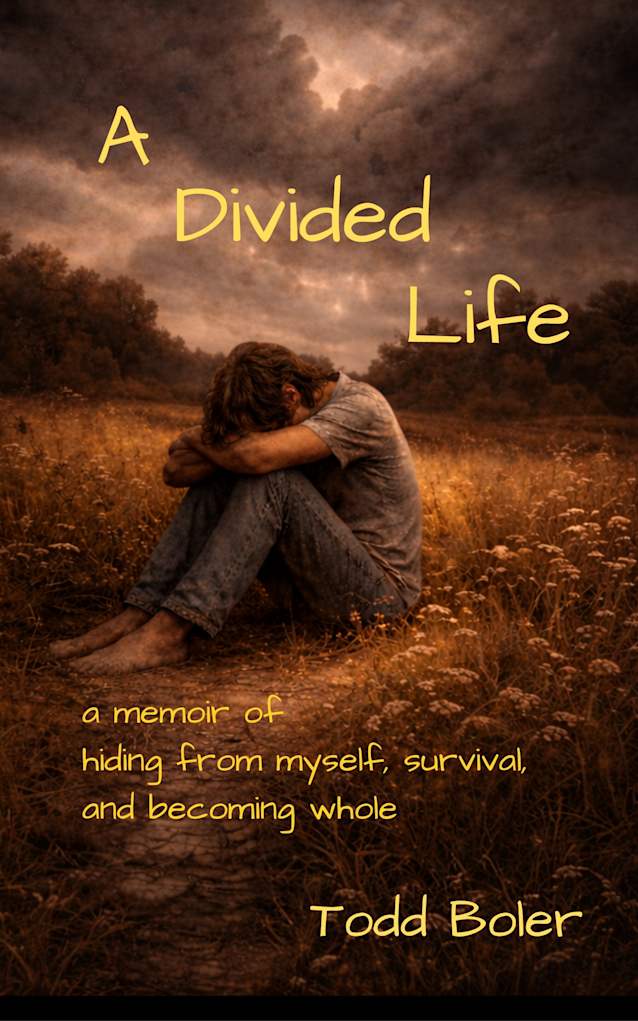
A Divided Life
About
What happens when everything around you teaches you that an essential part of who you are must remain hidden?
In the tradition of Boy Erased, A Divided Life explores the destructive logic of conversion therapy—but from inside the mind of a young man who became both its subject and its enforcer. Growing up gay in a faith-shaped Midwestern town during the 1970s and 1980s, Todd Boler was never sent away to be changed. With no safe place to bring his questions, he built his own private system of correction, restraint, and moral bargaining.
Family, faith, friendship, and community offered real love, structure, and belonging, but also expectations Todd believed he could not meet as his whole self. To preserve those relationships and the life he knew, he adapted. Outwardly, he appeared capable, faithful, and “fine.” Inwardly, he became divided.
With candor, psychological insight, and unexpected humor, the memoir traces how compartmentalization, silence, bargaining, and emotional restraint helped him endure. Practical Brain kept daily life functioning. Irrational Brain kept asking questions. Shame transformed Todd’s hidden identity into the “Gay Monster,” an imagined enemy he believed he had to defeat. Over time, the survival system reached its limit.
The turning point comes on a freezing country road in January 1985, when everything Todd believed about himself narrows into a potentially fatal conclusion—but then gives way to a quieter truth: the part of himself he had been fighting was not evil. It was simply him.
This is not a dramatic coming-out story, and it does not reduce the people Todd loved to villains. Although rooted in one gay life, A Divided Life speaks to anyone who has hidden part of themselves to preserve a relationship, satisfy an expectation, remain in a community, or simply belong. It is a relational memoir about the intelligent ways people adapt when honesty feels unsafe, the limits of those survival structures, and the difficult but possible movement toward self-recognition, reconciliation, and ordinary wholeness.
For anyone who has appeared “fine” while hiding part of themselves to belong.